Pages

Monday, June 17, 2013

Translation and Transliteration Problems


Arabic is classified as one of two of the hardest languages for English speakers to learn, the other being Mandarin Chinese.  The same is true for Arabic speakers learning English.  It is quite admirable that so many Egyptians have learned at least some English.  Please don't misinterpret this post as somehow making fun of the efforts of all those who are making our lives easier.  We are truly grateful for these people.  Nevertheless, it can be amusing when the translations don't work out quite right!


Most things on the menu looked fine, but I might only order #84 for a bridal shower...


Sounds vaguely cannibalistic, I'm not sure I'd feel comfortable sending a child there!

Seems pretty bossy...


At first we thought they might be selling lighters, but we realized after thinking about it that they were renting 'bikes'. 


The words 'lamp' and 'light bulb' are identical in Egyptian Arabic.  While it seems this would be somewhat confusing for them, it definitely leads to translation problems for us.


Ignore this one if you aren't a grammar nerd.  Egyptian Arabic is a 'slang' version of Arabic.  As such, they use a lot of short cuts.  The most common one is to use participles instead of regularly conjugated verbs.  When translating word-for-word the result is... less than ideal.  


We also find amusement in the fact that Arabic does not have the sound for the English letter 'p'.  Usually English-speaking Egyptians substitute the letter 'b'.  The results can be quite confusing as happened yesterday when a guy talking to my husband referred to his 'iBad'.  We are also often thrown off by phrases such as ' beberoni bizza' and being asked if we want to 'bay now'.   Here is an excellent example of this problem being over-corrected:


Friday, May 3, 2013

Whale Bones in the Desert

On Christmas Eve we were invited to go with some friends out to the desert.  We went to an area about an hour outside of Cairo where you can see ancient whale bones.  The Sahara at one point was covered in sea water and there are many different fossils left scattered all over the desert.

On the way we stopped to see Egypt's only waterfall:


The picture doesn't allow you to put it into perspective, but it was only about 12 feet tall— a cute, little waterfall.  Still, it's not something you normally see in the middle of a desert!

I must say I was initially a bit underwhelmed when we got to the whale bones.  They were not the huge blue whale ribs that I expected to see popping out of the sand.  Being ancient whales, they were much smaller, about 6-10 feet long total.


There were also some turtle fossils:


It was nice to see a site in Egypt where ancient treasures are being cared for and preserved.  A sharp contrast to another fossil site we visited in Siwa where we were allowed to simply pick up and walk away with equally ancient shells!

A Break From Egypt

In need of a break from both work and the restrictions of Egypt, we went to France for 10 days at the end of April.  Although it was much cooler than we are used to and it rained a lot we still enjoyed ourselves very much.  The air was clean, the rivers were perfectly clear, the food was amazing (of course!), and people were very friendly.

We flew into Paris, but as we had both been there several times before we decided to spend most of our time elsewhere.  Our first stop was in the Loire Valley, about an hour outside of Tours.  We stayed at a small renovated chateau owned by a very nice British-French family.


In the five years they have owned the property they have completely renovated the main floors, established a flock of sheep, a goat, a donkey, five chickens, and four of their own children.  They also have one field planted, a kitchen garden, a small orchard, and a swimming pool.  In addition they have a full-time chef who prepares breakfast and dinner for the guests every day.  Needless to say, it was a wonderful place to be! 


The Loire Valley is known for its large amount of chateaus.  Being relatively close to Paris, French noblemen and royalty built palaces for themselves out in the countryside for hunting and summer homes.  The one we stayed at was relatively small, but we visited another that is the most elaborate of them all, Chenonceau. 


The chateau was originally build in the 11th century and, as you can see, was built over a small river. 

Even though it was still very early spring in France, the gardens were absolutely beautiful.  


Knowing that it can be rather cool in France still at the end of April, we chose to spend the majority of our time in Provence where it is always warm and sunny.  We stayed in Avignon and planned several day trips to see the surrounding countryside, Provencal villages, and the local Roman ruins.  What we didn't plan on was climate change.  Instead of the warm and sunny Provence that had been advertised we experienced temperatures from the upper 30s to a high in the mid-50s.  In addition there was more rain than the locals had seen in 20 years!  Our lovely tour guide, Michelle, felt so sorry for me and my Egyptian wardrobe that she loaned me her down jacket for two days.  Nevertheless, we very much enjoyed Provence.

Avignon is famous for two things- its bridge and its brief stint as the home of the Roman Catholic pope.  The bridge has been mostly destroyed by floods, but there is one section still standing.


The Pope's Palace is very large and includes the Avignon Cathedral on its grounds.  Only the cathedral is still in use, as the pope has long since moved back to the Vatican.


We were lucky to have Michelle as a tour guide for two full days.  On the first day she took us around to some of the more famous villages in Provence.  We got to see a market in Carpentras (I bought some shoes, John got olives) and a town called Roussillon, which means Red Village.  There is a red tint to the earth in the area which the locals use to paint all their buildings.


Also in this village was a grape vine that was 167 years old!  You can see it growing over the doorway in the picture below:


One of the other memorable towns was Fontaine-de-Vaucluse, located in the Vaucluse Mountains of Provence.  Just outside the town is a spring that looks perfectly calm:


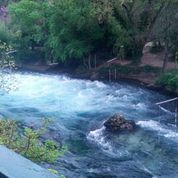
However, the amount of water coming out of the spring is so large that it spills over into a very vigorously flowing river:


Apparently people have tried to figure out how deep this spring is, due to the large amount of water coming out of it, but they have been unable to find the bottom of it, even with sonar.

Our second day out with Michelle we went to see the Pont du Gard.  This is part of a 130km long aqueduct built by the Romans.  Most of the aqueduct is underground, and large parts of it are no longer intact.  The Pont du Gard, however, has been very well preserved.  It was raining quite steadily during our visit, but we did get a few pictures:


The part of the bridge that people can walk across is actually a second bridge that was built in the mid-1800s.  It exactly parallels the old bridge so it doesn't distort the view from a distance, but it does protect the old stones from more wear and tear.


After seeing this bridge the rain picked up and we couldn't get any more pictures.  We spent the rest of our time practicing French (my husband is getting really good!) and relaxing.  It was very nice to spend some time in the developed world, and a bit of a challenge to come back to the craziness of Egypt.  But we have less than three months left!

Wednesday, April 17, 2013

Loans

Qur'anic law does not allow followers of Islam to either earn interest or pay interest.  This presents some real challenges to people in the Middle East as they continue to participate more and more with the rest of the world economically.  Stock exchanges and people who invest in stock have to be very careful that they are neither earning interest nor gambling (another forbidden activity).  On a personal level, individuals cannot earn interest on their bank accounts and they cannot take out interest-earning loans.  They also cannot carry a balance on a credit card which would require them to pay interest.

My Arabic teacher described for us an ingenious system that has developed to work around these requirements and still obtain large lump sums for various necessities.  In her case, she needed money to pay her children's tuition.  At many places of work, and in nearly every neighborhood, people band together to form 'associations'.  They agree on a person to act as mediator and make monthly payments for a specified term.  Each month, every member of the association pays their agreed upon sum to the mediator.  The mediator then selects one member to receive all of the money for that month.  Members can request their payment for specific months, or they can just wait their turn for their payment.  In my teacher's case, she joined an association a month before school started and requested her payment for the first month of school.  The tuition being paid, she then continues to make her monthly payment for the term of the association so that all the other members can receive their lump sum in turn.  This device accomplishes the two goals of receiving a lump sum of money when needed and not having to pay interest to obtain it.

The other students and I admired the cleverness of this system, but we also wondered what the problem was with interest.  Apparently the prophet Muhammad has stated that paying interest is a worse sin than murder, stealing, and adultery.  Our teacher explained that while these other sins harm the doer of the act and the one it is being done to, paying interest is a sin that affects the whole community.  While I personally think that all of these things harm the whole community in some way, there is no doubt that many of our current world-wide economic woes can be attributed at least in part to the pervasive harm of usury.

I find myself often frustrated with the way of thinking here in Egypt that finds the reasons for doing everything from the Qur'an and the life of the prophet Muhammad.  There is very little evidence of critical thinking skills in most people's lives- they do the things they do because that is what their religion teaches, from how to conduct a government down to what oil is the best remedy for skin afflictions.  But in this instance of dealing with usury, I admire the way people have adapted.  It would be unreasonable for us in the West to forgo all interest payments completely, but it probably would not hurt for us to reflect on the harm that has come from our current system!

Thursday, March 21, 2013

Spring in Cairo

I have no idea what most of these flowers are, but I have been enjoying them blooming the past few weeks.  They make grey and dusty Cairo seem much more friendly.  These flowers are inside and just outside of our building:


These are trees blooming around Maadi.  The first tree smells really nice— a good antidote to traffic exhaust fumes!


A close-up of the tree above.  The flowers are bigger than my hands!


These last two are poinsettia bushes(!) and bougainvillea growing up into a tree.


Wednesday, March 20, 2013

Learning Arabic II

My Arabic lessons have continued steadily since they began in September.  I am making some progress, but it is slow.  I was proudest of one of my recent homework assignments, which was to write out the story of Little Red Riding Hood.  This was excellent writing, vocabulary, and grammar practice, and a whole lot of fun.

The assignment I had to turn in today was a set of sentences using the complicated numbering system in Arabic: number one has a masculine and a feminine form, number two gets shortened, changed to masculine or feminine, and attached to the end of the noun it modifies, numbers three through ten have shortened forms that follow a plural noun, and numbers 11-100 use their long forms after a singular noun. 

As I exited the staircase on my way to class I encountered my good friends and informal Arabic teachers— Ibrahim the janitor, Hashem the security guard, and Ahmad the maintenance worker.  Ibrahim and Hashem are my most persistent instructors, and it was Ibrahim that came up with a creative way to help me remember the days of the week.  He assigned a day to the men that regularly work here.  He himself is Goma (Friday) and Hashem is Khamis (Thursday).  Ahmad has become Ilsubt (Saturday).  The rest of the days are randomly assigned to whoever is standing around at the time.  Even though I have moved beyond these vocabulary words, Ibrahim finds this a hilarious joke that he repeats nearly every time he sees me. 

So this morning when I ran into these men and they saw me with a notebook they got all excited.  When they found out I was going to an Arabic class, I offered to show them my homework and they seemed thrilled.  Hashem is the most literate of the three and he took charge.  After reading the first sentence he asked me for a pencil.  He and Ahmad carefully went through each sentence, correcting the spelling (the grammar, surprisingly, didn't need correction).  When they reached sentence number six and found no errors I was congratulated enthusiastically.  By the time they finished all the sentences I was late for class, but I had (almost) perfect homework.  It didn't occur to me until later that Ibrahim had quietly disappeared when the homework came out.  In spite of his enthusiastic teaching, I have been suspecting that he is functionally illiterate.  A large portion of Egyptians are, and that contributes to many of their economic and social problems.

Needless to say, I had some explaining to do when I handed in my homework.  Fortunately, my teacher is very laid back and was entertained by the story.  It turns out that Ahmad and Hashem were assuming that I was writing in Modern Standard Arabic so several of their corrections weren't quite right for my assignment in Egyptian Colloquial Arabic.  Nevertheless, I sincerely appreciated the time these men take to encourage me and help me out.  Language lessons are not at all part of their jobs, but they, like many Egyptians I have met, seem to make it their personal mission to help all foreigners learn their language.  As Arabic is as hard for English speakers as Mandarin Chinese, we can certainly use all the help we can get!

Monday, March 4, 2013

Not for the Faint of Heart


Between food poisoning and traveling it had been a couple of weeks since I had done a really thorough house cleaning.  This afternoon I started to rectify the situation.  When we dust, not only do we have to dust the normal things, we also have to dust several of the doorways.  In three of our rooms the air is being continuously sucked out of the house— the two rooms that house our HVAC units, and one of the bathrooms.  The doors to those rooms stay closed most of the time, so dust and dirt collect in the doorway.  This is what it looks like after a couple of weeks:


Fortunately, it wipes away fairly easily:


But I'm left with super gross dust bunnies:


Since the doorways were particularly bad, I decided to check our air filters.   The washable filter came out first and it was almost completely black:


A good vacuuming mostly took care of the problem:


The HEPA filter, however, was in much worse shape.  We are waiting for a new one to come in the mail, so I tried to vacuum out this one to nurse it along.  Here it is with one corner vacuumed:


Even though the cleaning was only somewhat successful, the air in the room is noticeably better now.

Cairo consistently lands on Top 10 lists for air pollution, but it has never been at the top of the list.  I cannot even imagine what this chore would be like in Beijing!